Our Collection
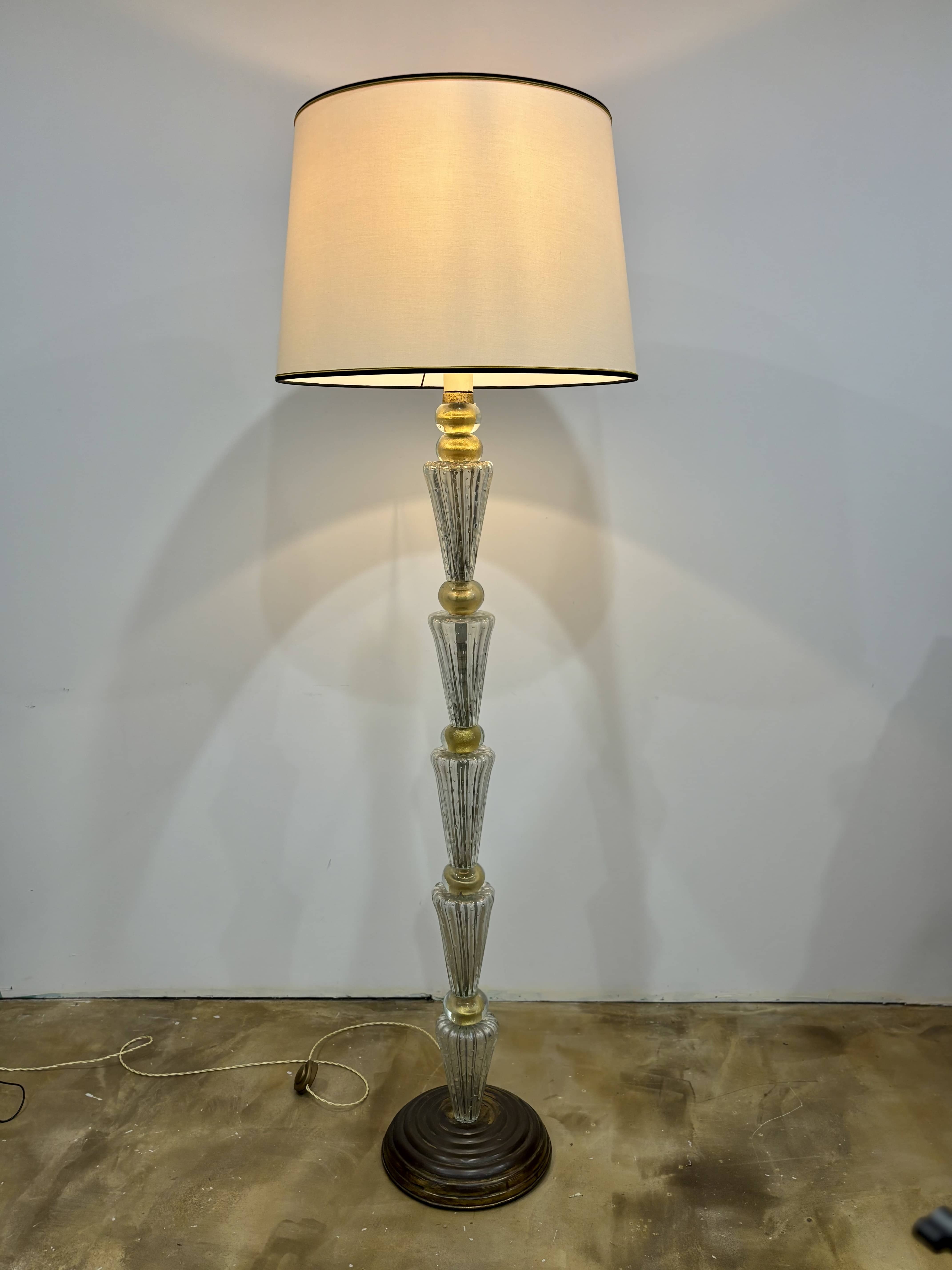
Large and elegant Murano glass floor lamp, emblematic of the exceptional craftsmanship of mid-twentieth-century Venetian glassworks (in the taste of the creations of Barovier & Toso or Archimede Seguso).
- The Shaft : The slender central shaft is composed of an alternating stack of balusters and geometric elements in ribbed and bubbled clear glass, alternating with elements in glass with gold inclusions, offering a superb visual contrast and beautifully capturing the light.
- The Base: The whole rests on a circular base in moulded metal, formerly gilded. The gilding, partially faded by time, today reveals a lovely dark brown patina with traces of gilt.
- The Shade : It is surmounted by a large shade in ecru/greige fabric, bordered with a black braid highlighted by a gold piping with a twisted passementerie button detail, ensuring a soft and warm diffusion of light.
- Excellent state of preservation. No cracks, chips or nicks on any of the glass elements.
- Electrical wiring entirely renewed to current standards (twisted silk-effect textile cable in gold/brass, foot switch and standard bulb holder). Ready to be installed.
Italy, circa 1940-1950
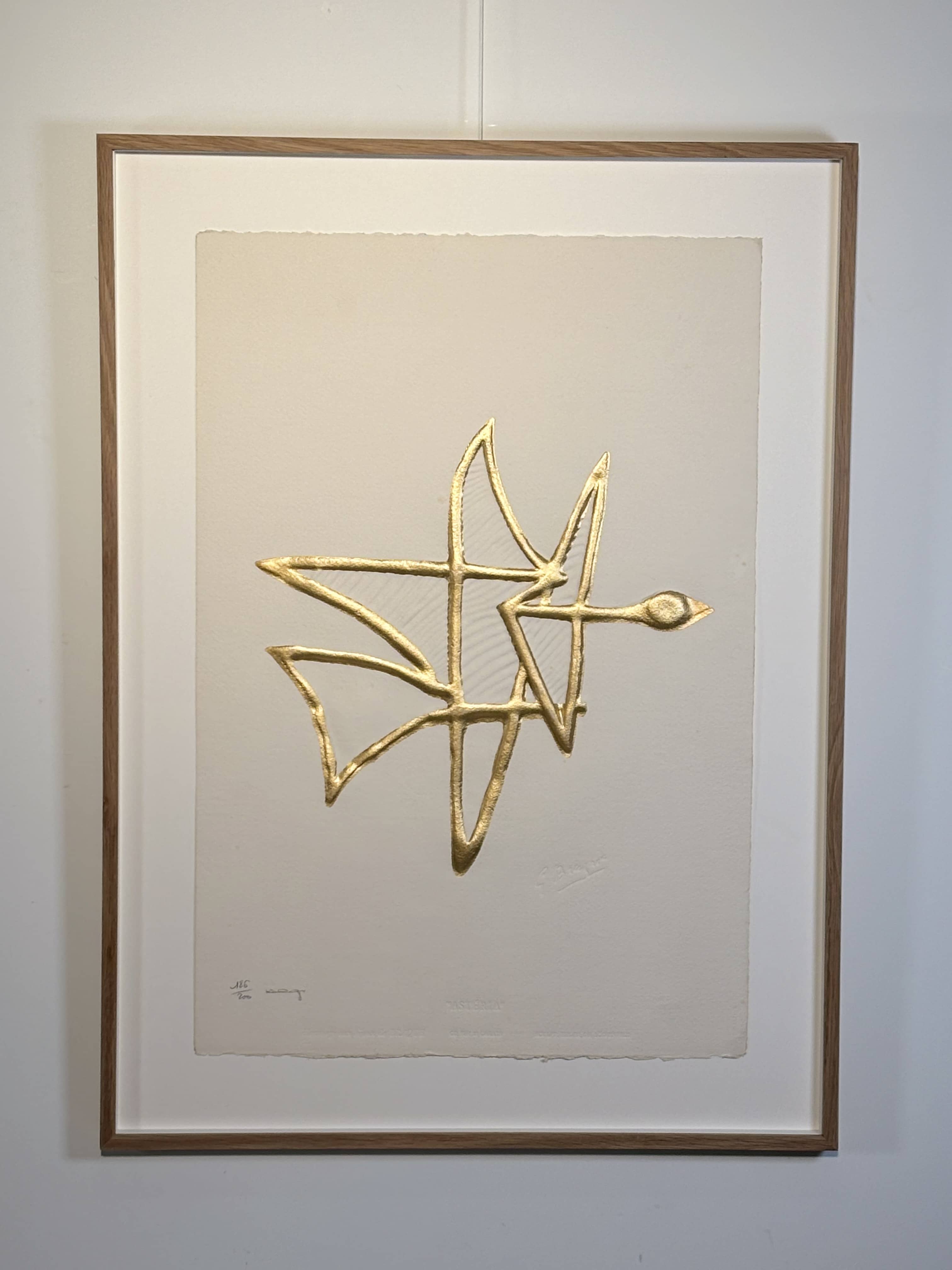
After Georges Braque (1882–1963), Astéria.
A very fine embossed print, gilded with 23-carat fine gold, produced after a creation by Georges Braque by Baron Heger de Löwenfeld, the artist’s collaborator in the realisation of his celebrated jewellery.
The work belongs to the suite “Hommage aux bijoux de Braque”, devoted to the jewellery creations conceived by Georges Braque at the end of his life and transposed in relief by Heger de Löwenfeld.
On thick, deckle-edged paper, the composition is treated in deep embossing: the motif, entirely gilded in fine gold, genuinely stands out from the sheet, lending it an almost sculptural character.
The subject, Astéria, belongs to the mythological repertoire so dear to Braque in the final years of his oeuvre. The figure is reduced to an ensemble of powerful, pared-down lines, midway between drawing, sculpture and jewel.
Example numbered 186/200 in pencil.
Signature of Heger de Löwenfeld in pencil, lower left.
“G. Braque” signature in relief / blind stamp within the sheet.
Numerous blind-stamped inscriptions in the paper:
“ASTERIA”; “Or fin 23 carats”; “Hommage aux bijoux de Braque”; “Sculpt. Heger de Löwenfeld”
Edition produced circa 1970–1971.
Examples from this suite are notably documented with the publisher Pierre de Tartas in Paris.
Presented in an elegant bespoke museum-quality frame under glass, the subject set on a raised mount, with anti-reflective and anti-UV glass. Oak borders.
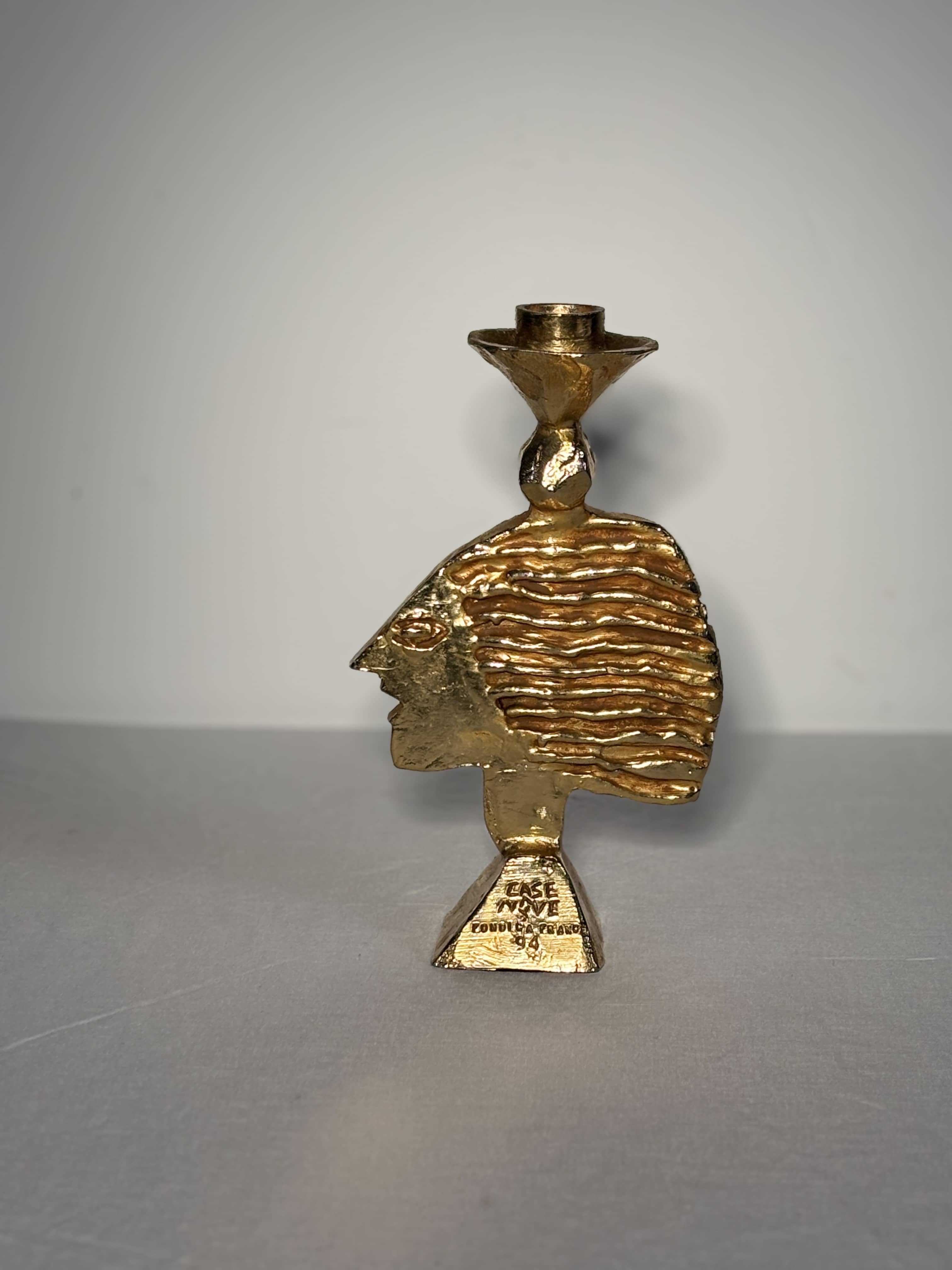
Gilt bronze candlestick signed Casenove, foundry mark Fondica, dated 94 (1994).
In perfect condition.
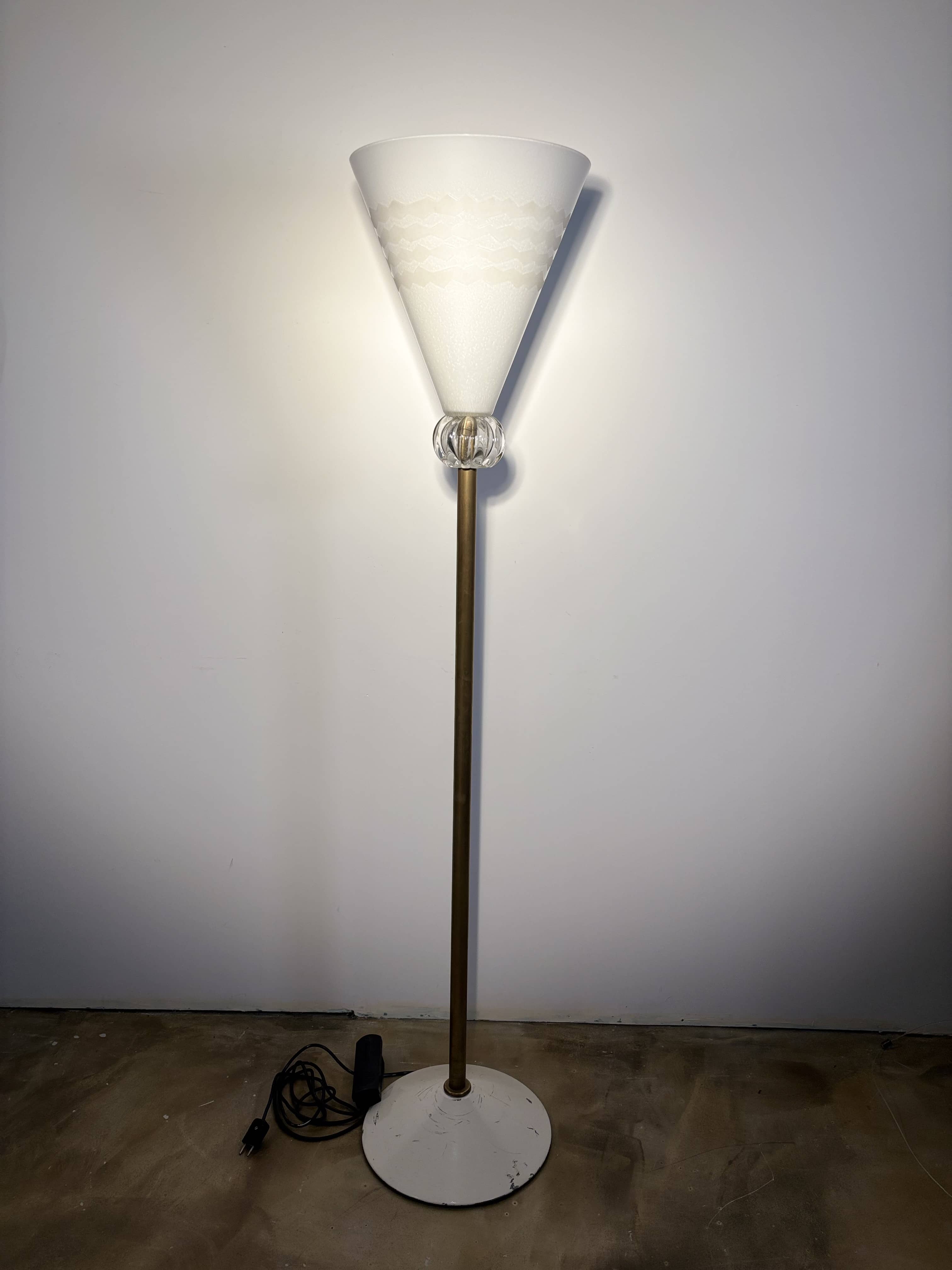
Italian floor lamp signed Barovier & Toso, Murano, with original label preserved (Barovier & Toso lozenge logo + certification label “Vetri Murano VM 007”, label of the Consorzio Venezia Vetro used between 1981 and the early 2000s).
The conical shade in blown opaline glass, with the granular texture characteristic of Venetian work, is adorned with a frieze of waves acid-etched on its lower third, drawing upon techniques and a decorative vocabulary inherited from the great years of Venetian glassmaking. It rests upon a sphere of colourless Murano glass, blown and cut with twisted ribs, which closes it onto the brass stem — a torchère-type floor lamp, the light being diffused upwards through the glass.
The shaft, in brass, descends to a circular base in white lacquered metal. Original foot dimmer.
Good general condition consistent with use. The lacquered base shows visible marks of use and micro-scratches (see photographs), without any effect on the structure or the functioning.
Glass and crystal sphere intact, without chip or crack.
Original electrics in working order.
Origin: Italy, Murano — Barovier & Toso, circa 1980.
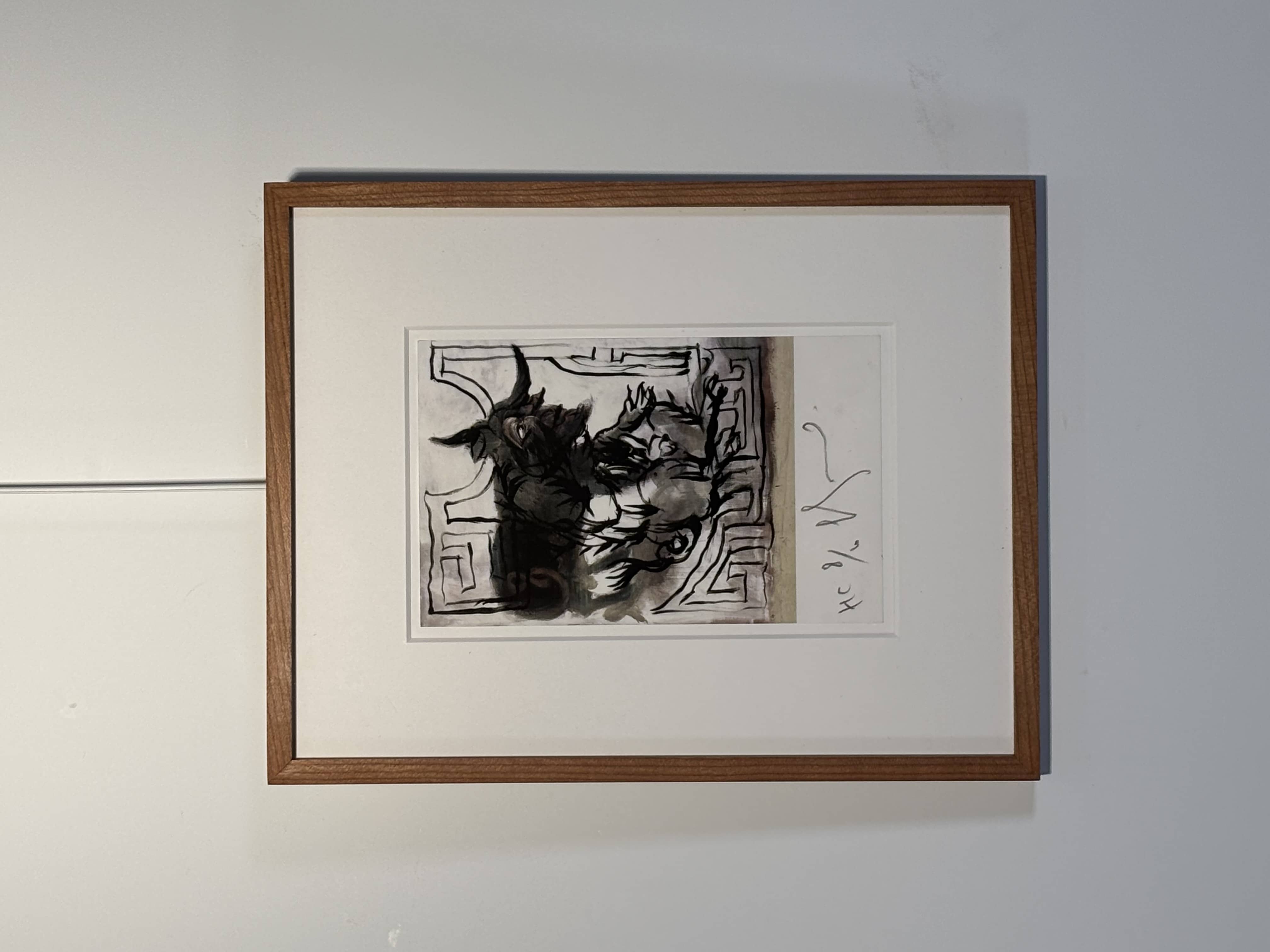
“L’Apiculteur et les Indiens” — a print by Gérard Garouste, Hors Commerce, signed and numbered 8/10.
The Minotaur emerges from a Grecian setting, with meanders and foliate scrolls drawn in black line, almost architectural in feel.
The face escapes this rigour: hand-painted in browns and pinks that soften the figure.
In Garouste’s work, “the Indian” is never a mere anecdotal detail. Ever since his play “Le Classique et l’Indien” (1977), the figure has embodied the painter’s double: opposite the Classical — reason, order — the Indian carries the savage, the mad, the uncontrollable. A theme he would explore for over thirty years, right up to his “Indiennes” series.
The full title of this print echoes that of a book Michel Onfray devoted to his painting in 2009.
Presented in museum-quality framing, with anti-reflective and UV-protective glass.
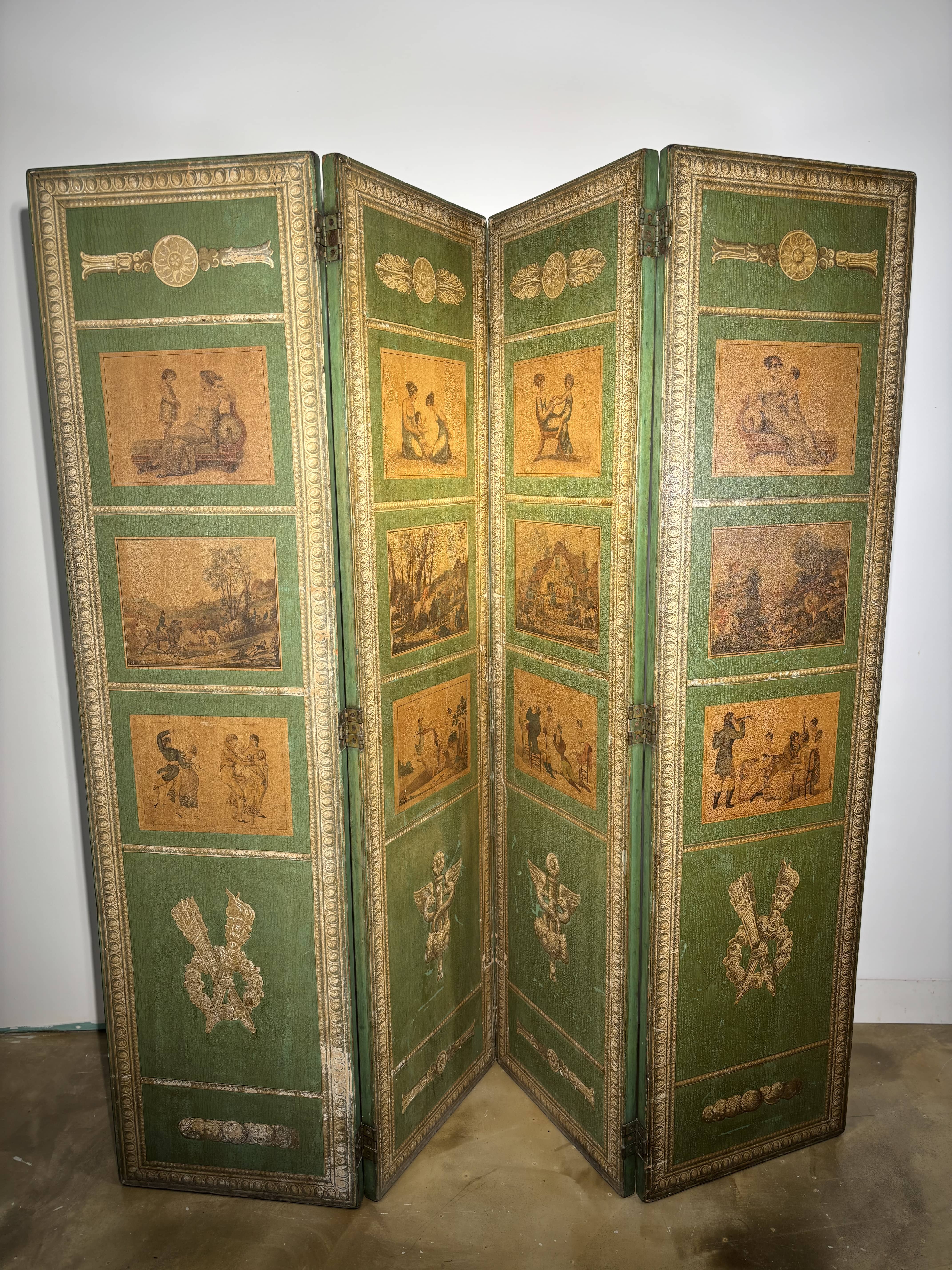
An exceptional and rare four-leaf screen presenting Arte Povera (or Lacca Povera) decoration on an antique-green lacquered ground. This piece constitutes a refined testimony to the taste of the Directoire period, marking the transition between the delicacy of the eighteenth century and the rigour of the First Empire. The decoration is composed of applied engravings after the works of Carle Vernet (1758–1836). One recognises the artist’s favoured themes: hunting scenes, genre scenes, and the neoclassical repertoire including winged caducei, quivers, torches and laurel wreaths. The Arte Povera technique consists of the meticulous application of engravings onto a painted support, the whole protected by numerous coats of resin varnish. The reverse of the screen is treated with equal care, presenting moulded panels painted in a tone of green. Late eighteenth / early nineteenth century.
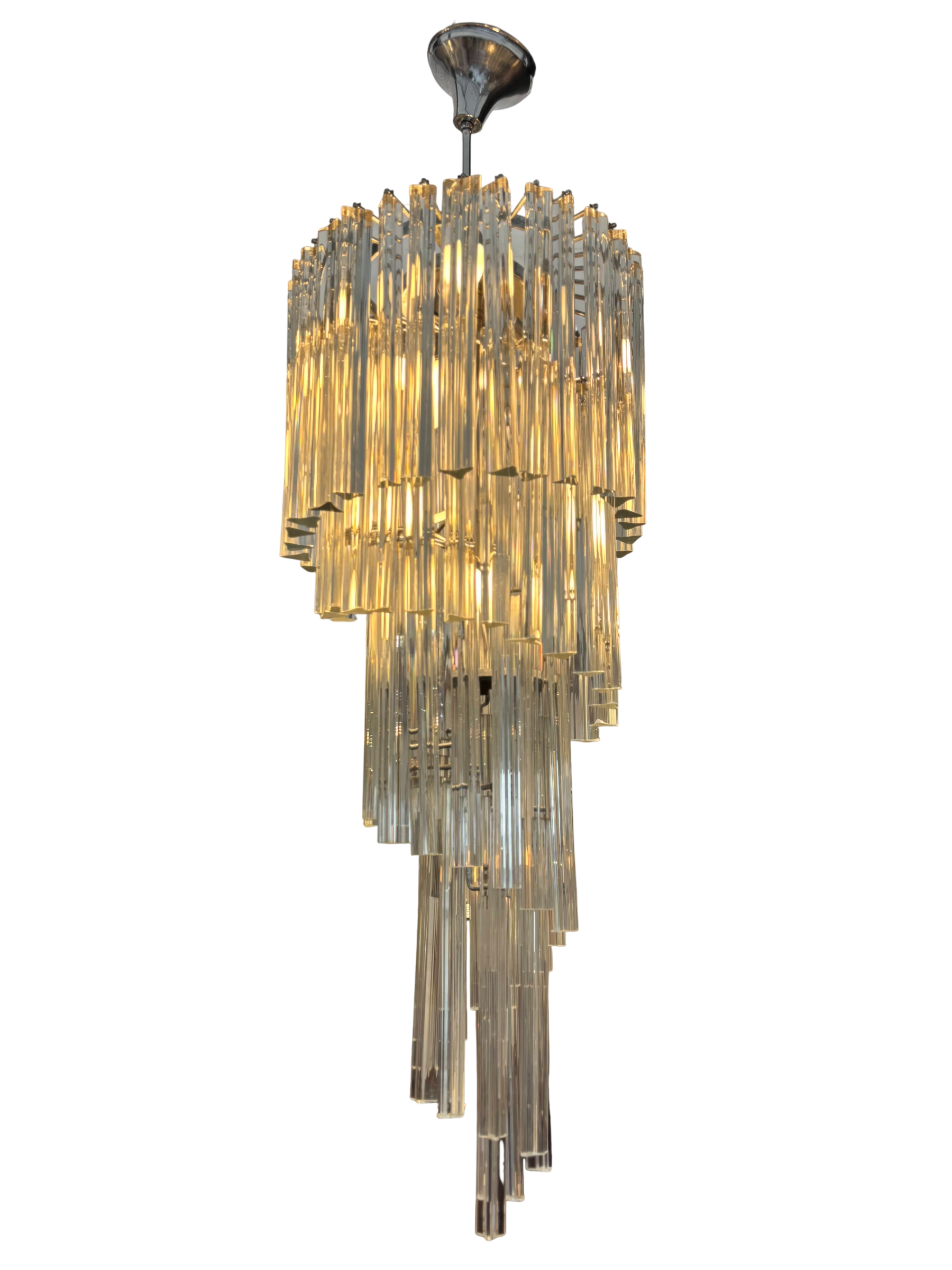
Spectacular Italian chandelier in Murano glass, composed of a multitude of long crystalline glass rods with prismatic section, arranged in a cascade and of varying heights.
The composition, particularly elegant and sculptural, forms an animated and airy silhouette, characteristic of the great Italian glass design of the second half of the twentieth century Venini, and of its productions notably including compositions using prismatic elements of the Triedri type, developed from the late 1950s onwards. The glass elements, of great transparency, offer magnificent plays of light and reflections when illuminated.
The chandelier features a silvered/chromed structure. The warm reflections visible in the photographs come solely from the lighting.
A very fine piece of character, monumental and rare, particularly suited to a contemporary interior, an entrance hall, a dining room or a space benefiting from a generous ceiling height.
Italy, circa 1960-1970.
Electrification redone by a professional.
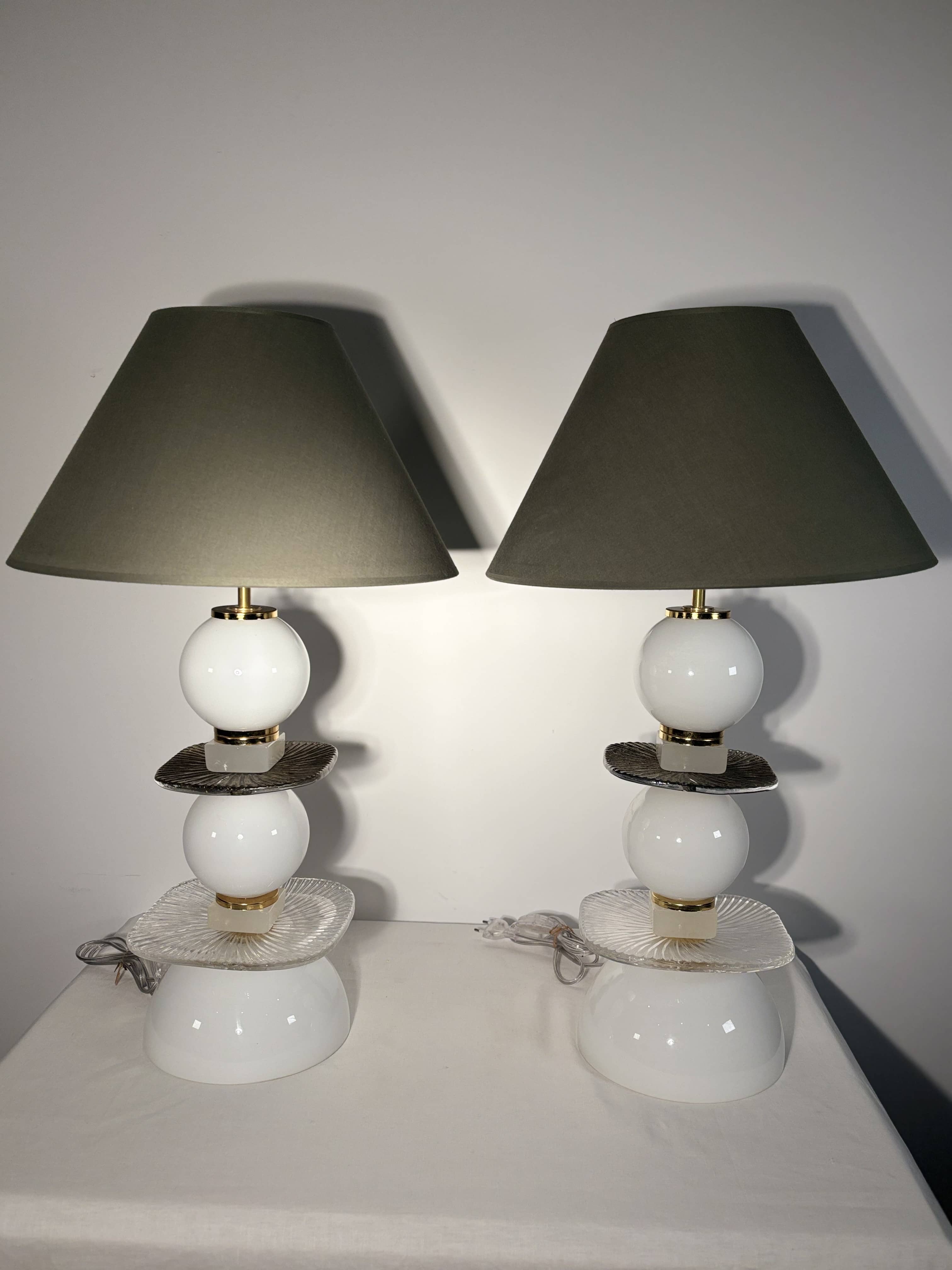
An elegant pair of postmodern/Hollywood Regency style table lamps, crafted in 1980s Murano glass and brass.
These light fittings are distinguished by a “totem” structure composed of a stack of various hand-blown glass elements, offering an interplay of textures and contrasts:
* White opaline glass: globes and a domed base in satin opaline glass
* Gold-leaf textured glass: intermediate discs in solid moulded blown glass, one translucent with radiating ribs, the other enriched with gold dust inclusions according to the traditional Murano technique.
* Geometric elements: Murano glass cubes that structure the architectural silhouette of the whole. The mount and separating rings are in gilt brass, accentuating the elegance of the materials.
The design is characteristic of the high-end Murano production of this period, in the spirit of houses such as Barovier & Toso or Mazzega.
Excellent state of preservation.
Electrics fully overhauled and refurbished.
Presented here with conical grey/green shades.
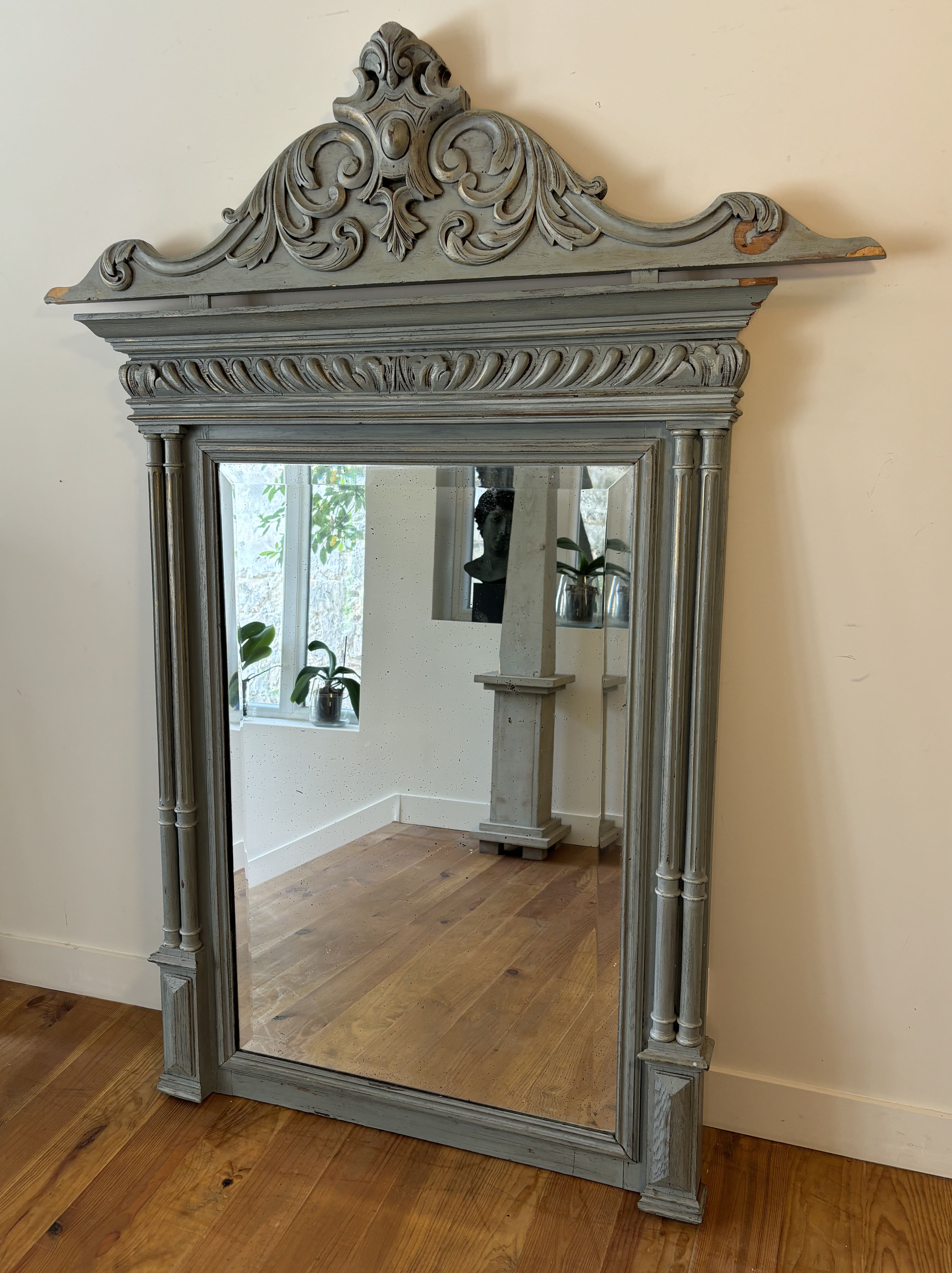
Large ornamental mirror with a cornice in grey-patinated wood. Applied and removable pediment. Mirror flanked by double columns on each side with pedestal. Original mercury glass. Lovely patina.
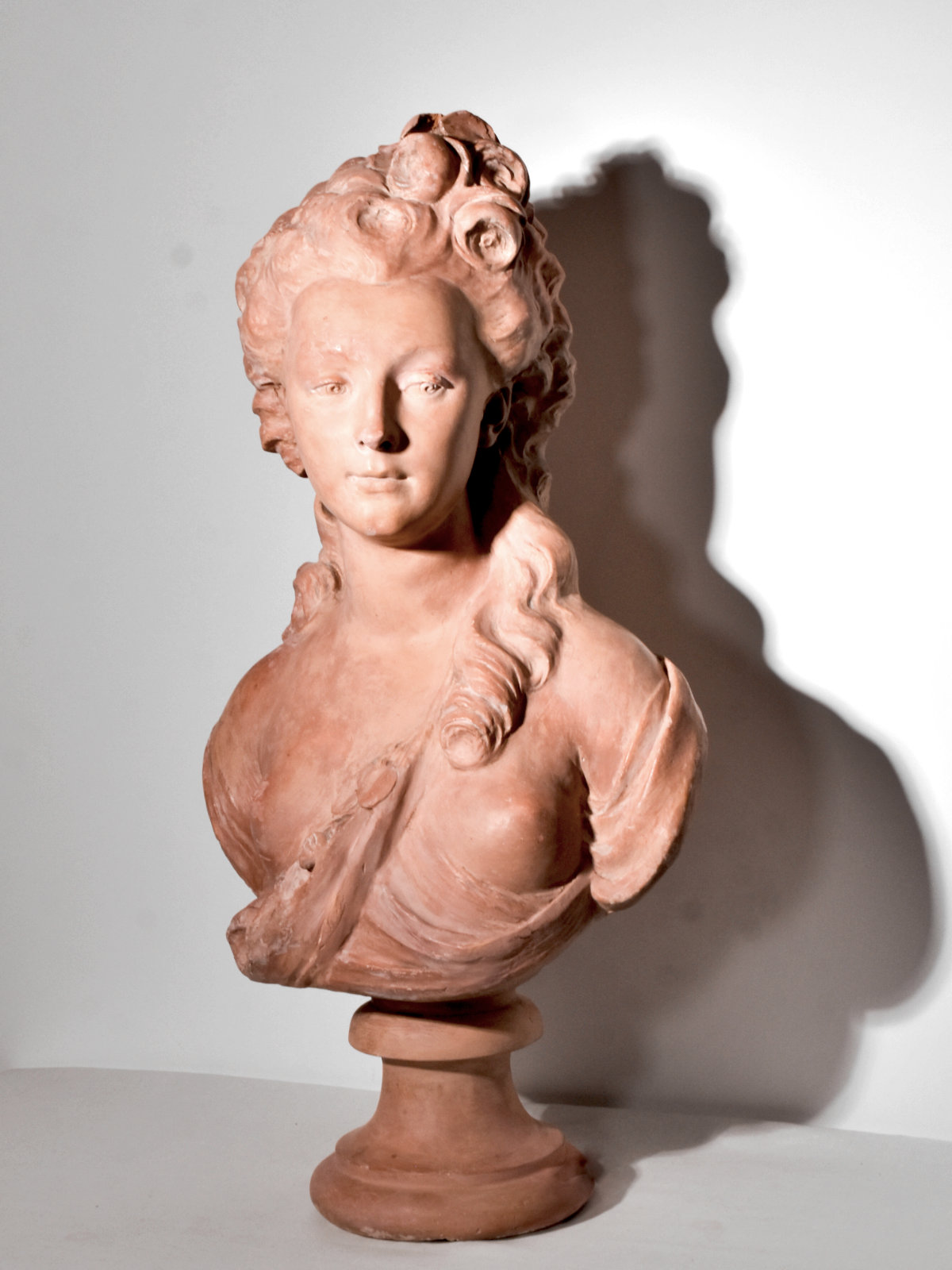
Imposing antique plaster bust with terracotta patina, depicting Mademoiselle Luzy, celebrated 18th-century actress and emblematic figure of the Comédie Française. This model is an edition after the original sculpture by Jean-Jacques Caffieri (1725-1792), the great Neoclassical sculptor renowned for his busts of eminent literary, theatrical and intellectual figures such as Voltaire, Diderot and Rousseau. The bust bears the stamp of the City of Versailles, attesting to an institutional provenance and a fine early edition. The execution is distinguished by the quality of the modelling, the precision of the detail in the coiffure and the elegance of the drapery typical of the Neoclassical style. Very good overall condition. Moulded signature JJ Caffieri on the terrace. Stamp: Ville de Versailles on the reverse. Early 20th century.
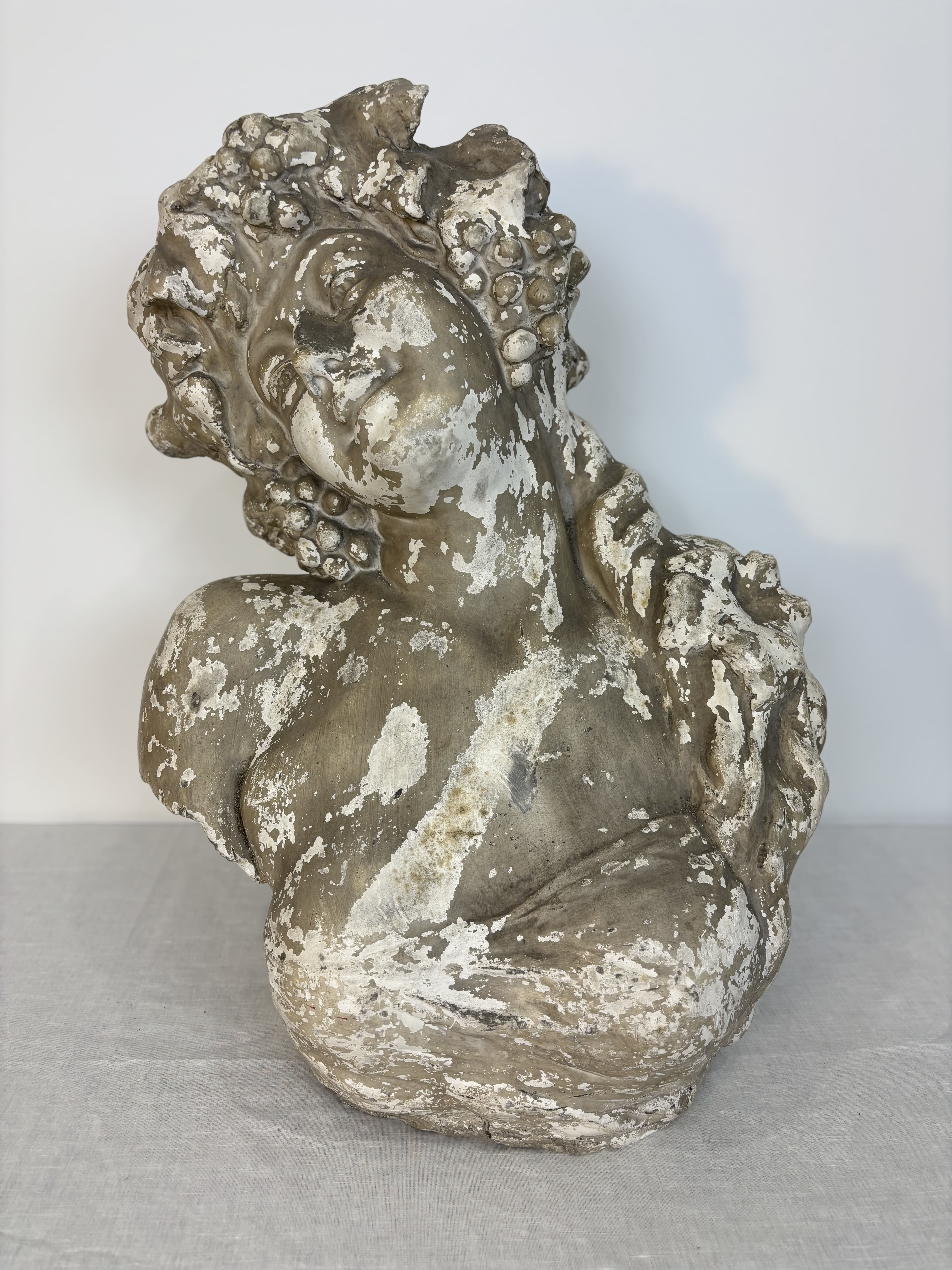
Large patinated plaster bust — Bacchante with grape clusters — Signed (Frans...) — Flanders or Belgium — Early 20th century. Spectacular and expressive, this large patinated plaster bust depicts a Bacchante, a figure associated with the cult of Dyonisos/Bacchus, her head tilted and adorned with grape clusters. The sculpture captivates through its scale, its movement, the charm of its dreamy countenance and the richness of the modelling of volumes typical of productions from the late Art Nouveau period. Acquired in Belgium, this piece bears an incised signature that is difficult to read, though the first name Frans is clearly identifiable, pointing to a Belgian or Flemish sculptor active around the beginning of the 20th century. Fine patina. Circa 1920.
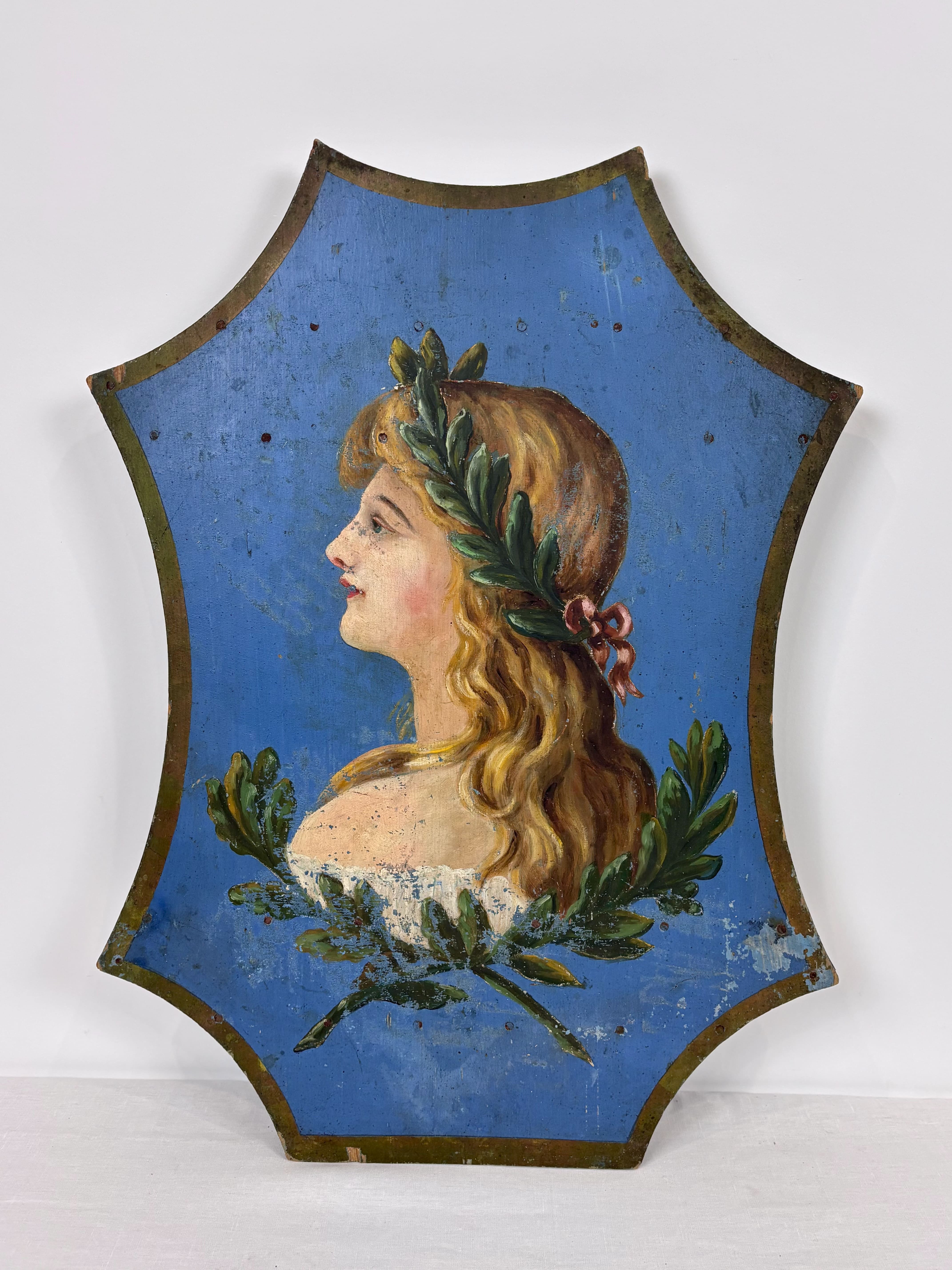
A superb decorative flag-holder / escutcheon from the late 19th century, probably Belgium or Northern France, painted on a wooden support. It depicts the portrait of a young woman in profile, crowned with a laurel wreath. The figure, her gaze turned towards the distance, evokes the female allegories employed in 19th-century decorative arts: muse, victory or republican figure. The piece features a shaped, scalloped format. The background is treated in a deep blue, enhanced by a painted frame in olive tones. Fine quality of execution.
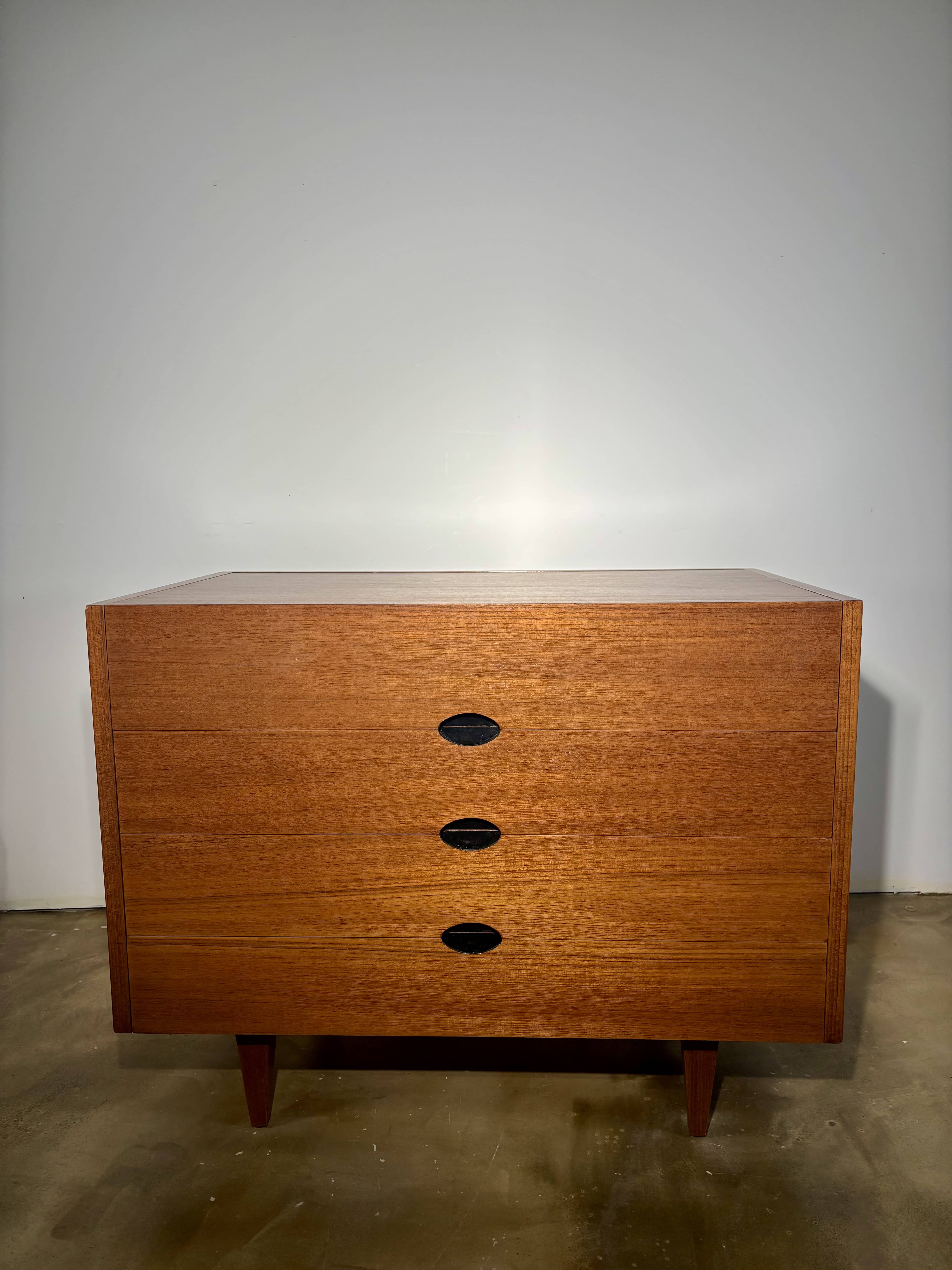
This piece takes the form of a compact chest of drawers resting on four slender compass legs, a signature of 1950s–60s design. The front, of great sobriety, is punctuated by three drawers with recessed oval handles in contrasting black, lending a discreet and refined graphic touch.
The teak veneer, with its warm and luminous tones, has been carefully selected to showcase a fine and regular grain.
The remarkable feature of this piece lies in its transformable system:
- The upper top opens by means of a lift-up flap- The inner face of this flap is entirely fitted with a mirror- A second mirror is integrated into the lower section (the top), creating a play of reflections and a true visual depth
- The sliding top extends towards the user, forming a functional shelf (dressing table or writing surface). This ingenious device, typical of 1960s design, perfectly illustrates the pursuit of space optimisation and versatility: a piece of furniture that is at once discreet and transformable, conceived for modern interiors.
Paul Geoffroy’s work is part of the post-war French modernist movement, influenced by Scandinavian design and functionalist principles. Here one finds:. Pure lines and balanced proportions. Restrained ornamentation. The pursuit of intelligent and modular use. Quality of execution and attention to detail. This piece bears witness to a design that is both elegant and pragmatic.
Traces on the silvering of the mirrors attest to their authenticity.
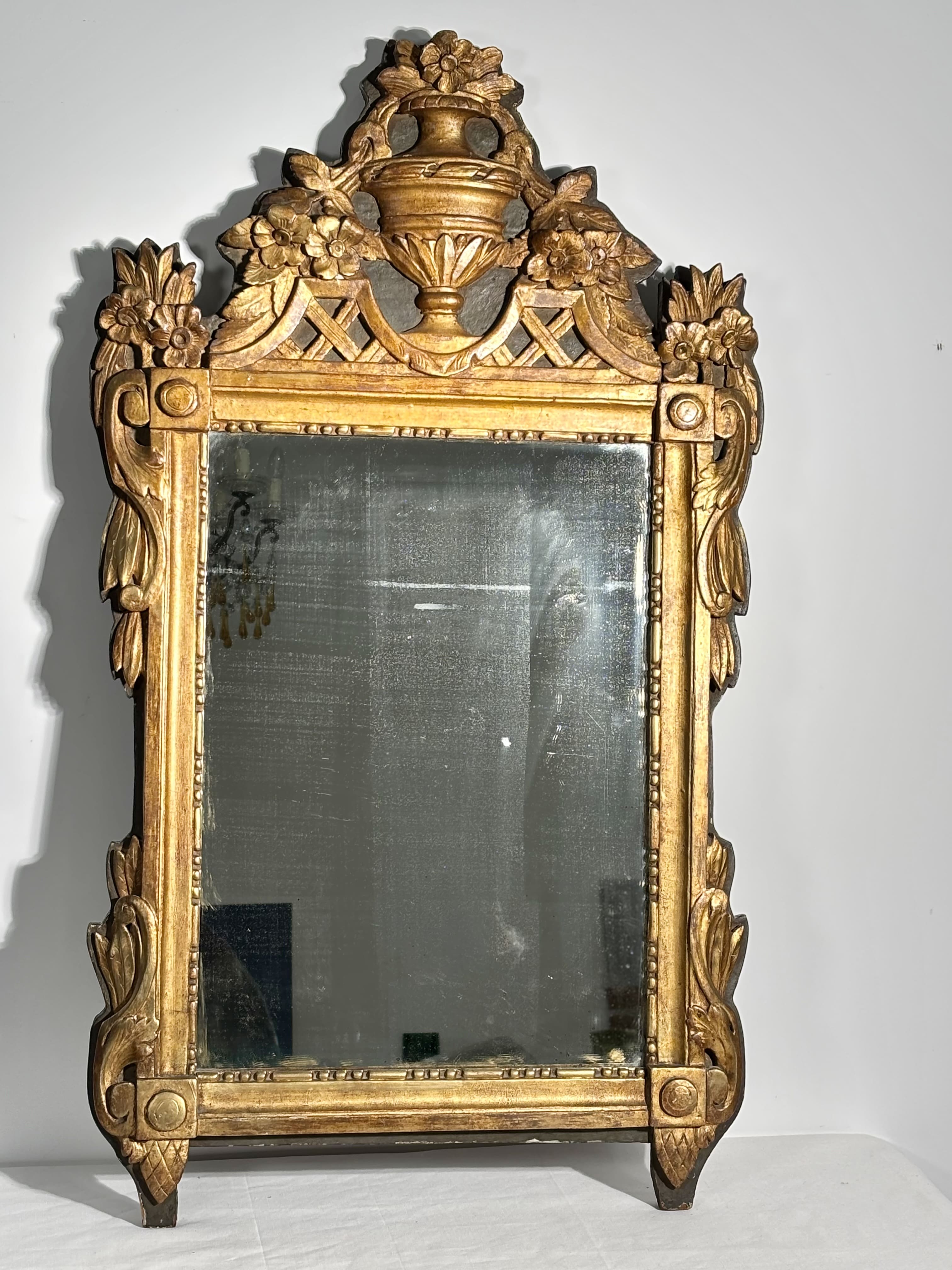
A fine pediment mirror, the giltwood and stucco frame highlighted by a frieze of pearls and broken batons, surmounted by a flowering vase finial. Mercury glass. Louis XVI period. France, 18th century
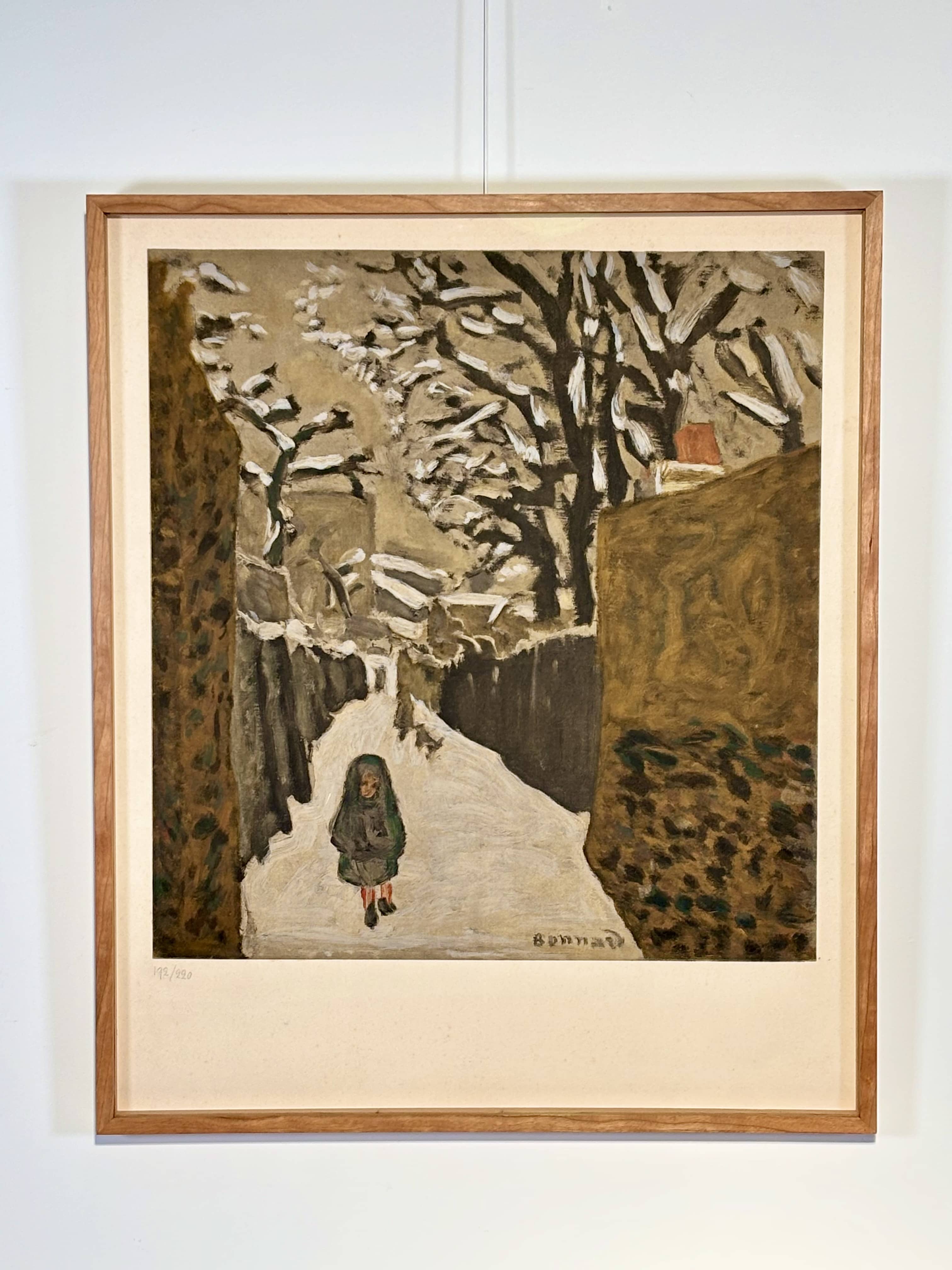
Colour print/lithograph on wove paper after the iconic work by Pierre Bonnard depicting an intimate winter landscape.
The composition opens onto a snow-covered path bordered by walls and trees with branches heavy with snow, at the centre of which a child advances, wrapped in a coat.
All the modernity of the post-Impressionist movement is present: tight framing, stylisation of forms, outlined touches of colour and a muted palette enlivened by the vivid accent of a chimney in the background and the child’s legs. A composition characteristic of Bonnard’s view of wintry Parisian street scenes.
The artist’s signature is printed in the plate at the lower right.
Numbered in pencil 192/220 at the lower left.
Posthumous reproduction, art edition type, from the 1950s–1970s.
The work benefits from a bespoke museum-quality frame under glass: anti-reflective, UV-filtering glass.
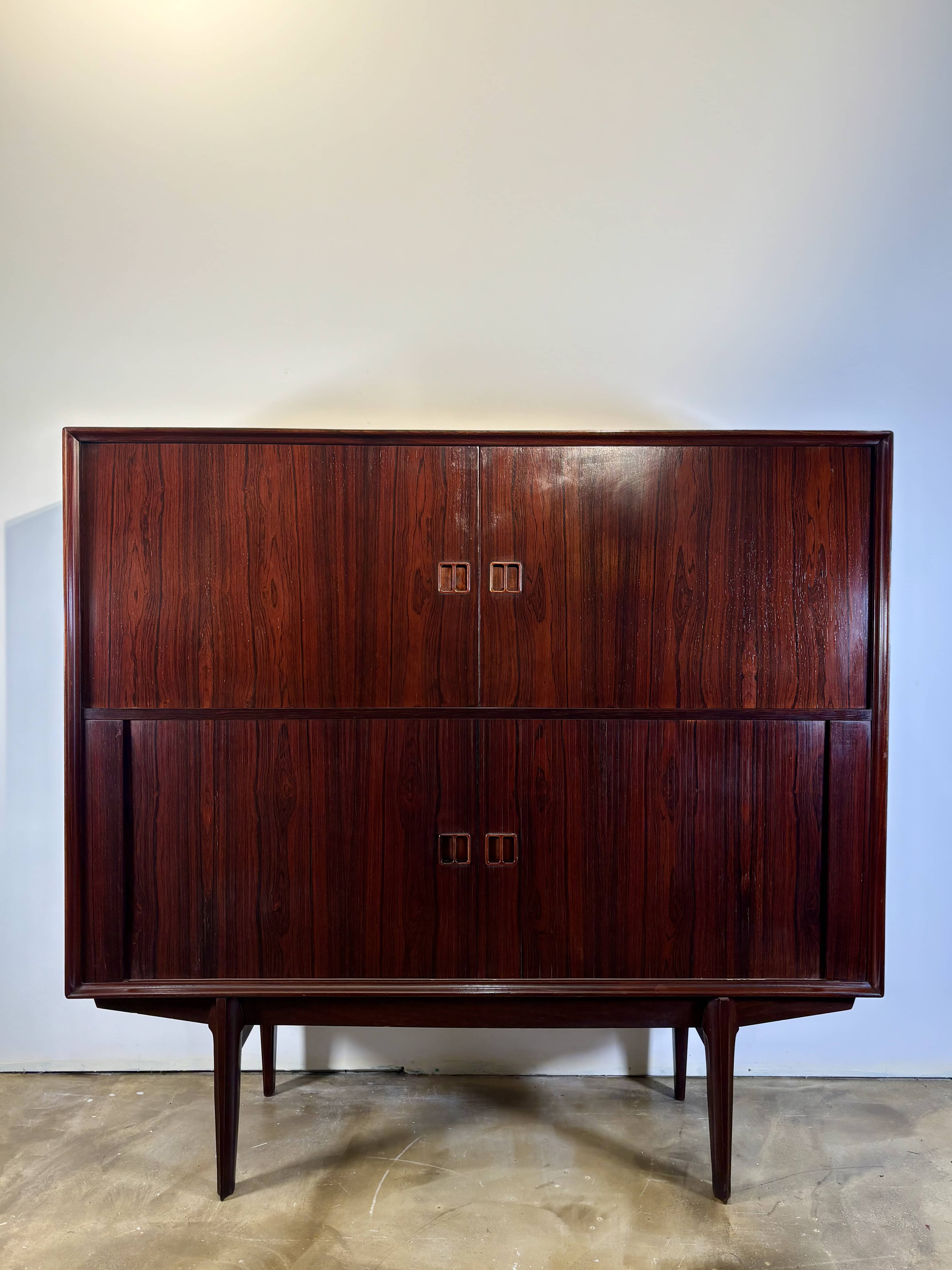
Exceptional Highboard-type storage cabinet (tall sideboard) designed in the 1960s by the celebrated Belgian designer Oswald Vermaercker. This masterpiece perfectly embodies the golden age of Belgian modernist design and the Scandinavian refinement that strongly influenced Belgian creation during the mid-twentieth century.
Quality of Materials and Woodwork:
This piece stands out for its use of Rio rosewood veneer (Brazilian Rosewood) of remarkable quality. The wood grain, dark, contrasted and deeply expressive, has been meticulously selected and applied in a “book-matched” pattern on the doors and the top. The flamed patterns of the rosewood lend this piece of furniture a unique sculptural presence and a highly decorative dimension.
Design and Features:
The cabinet presents a superb geometric façade divided into two distinct sections:
• Upper section: Opens with two hinged doors onto a fitted interior, comprising shelves and removable vertical dividers, ideal for use as a bar or writing desk.
• Lower section: Fitted with two sliding doors that optimise space, revealing wide adjustable storage shelves.
The signature detail lies in its handles: magnificent rectangular finger pulls, carved in relief directly from the solid wood, typical of Oswald Vermaercke’s craftsmanship. The whole rests on a slender, tapered sledge base, which brings an impression of airy lightness elegantly contrasting with the robustness of the cabinet’s body.
This piece is in excellent original condition. The original varnish has retained all its lustre, revealing the superb natural warm patina of the rosewood. Structure perfectly sound and stable. The doors and sliders operate smoothly. Rare minimal traces of use consistent with its age. Excellent condition, very beautiful patina.
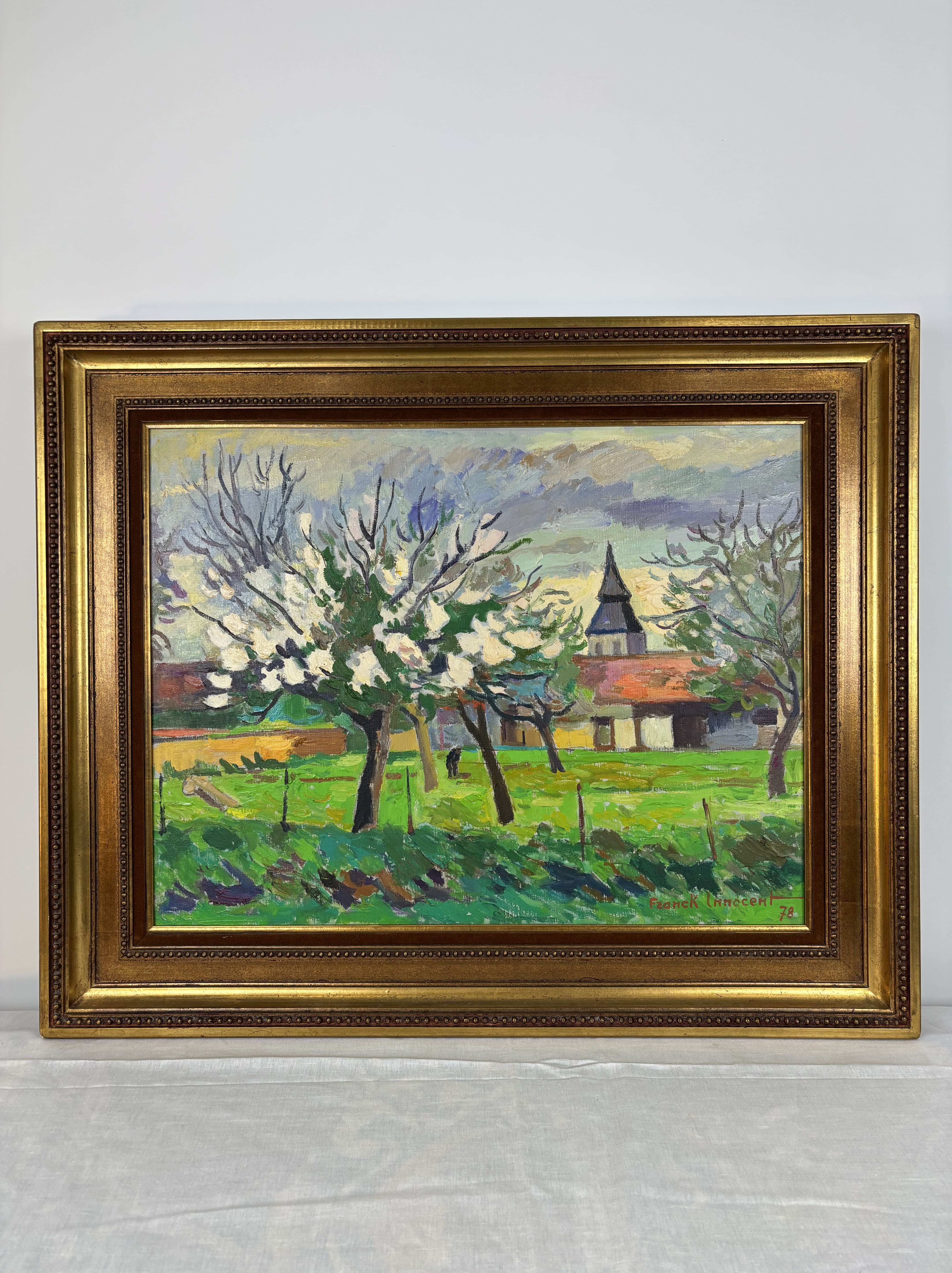
A very fine oil on canvas by the painter Franck Innocent, École de Rouen, depicting the Normandy countryside in springtime. Signed and dated lower right, countersigned, titled and dated on the reverse. With a dedication on the reverse: “to my wife, with my most respectful and grateful regards. 31.12.78. Jean” and “To my mother, to Vally, with all my affection. Pierrot”. Handsomely framed.
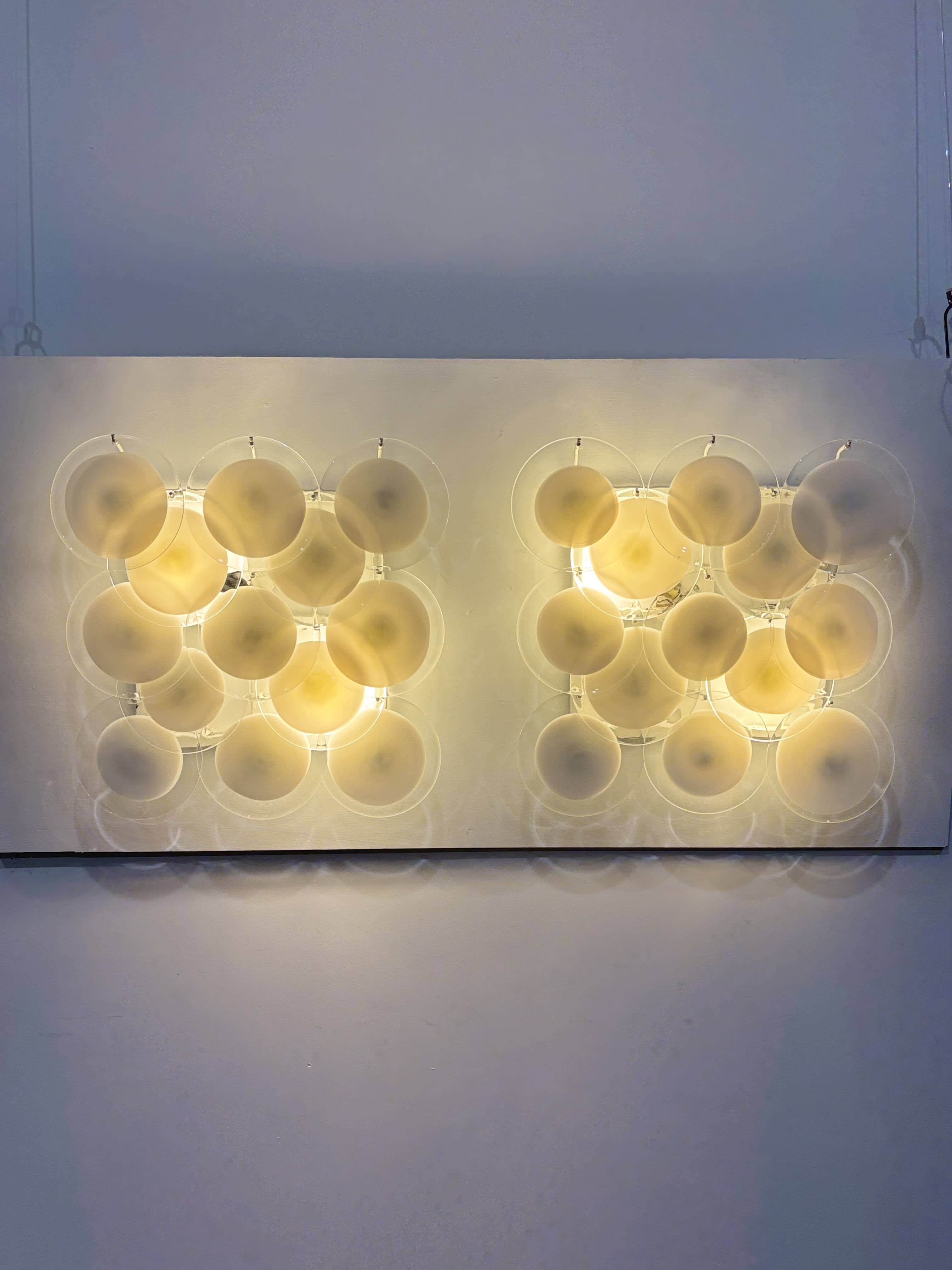
Nine mouth-blown glass discs, each presenting a satin white opaline heart encircled by a ring of clear crystal — such is the visual grammar of these wall lights from the Vistosi glassworks, one of the founding houses of Murano lighting.
Mounted on their original white lacquered metal structure, the discs reveal upon illumination a diffuse, warm and luminous halo of great softness and great elegance.
An iconic signature of twentieth-century Italian design.
A doubly rare piece: for its generous square format and for the fact that it is presented as a matching pair, intact.
Sold as a pair.
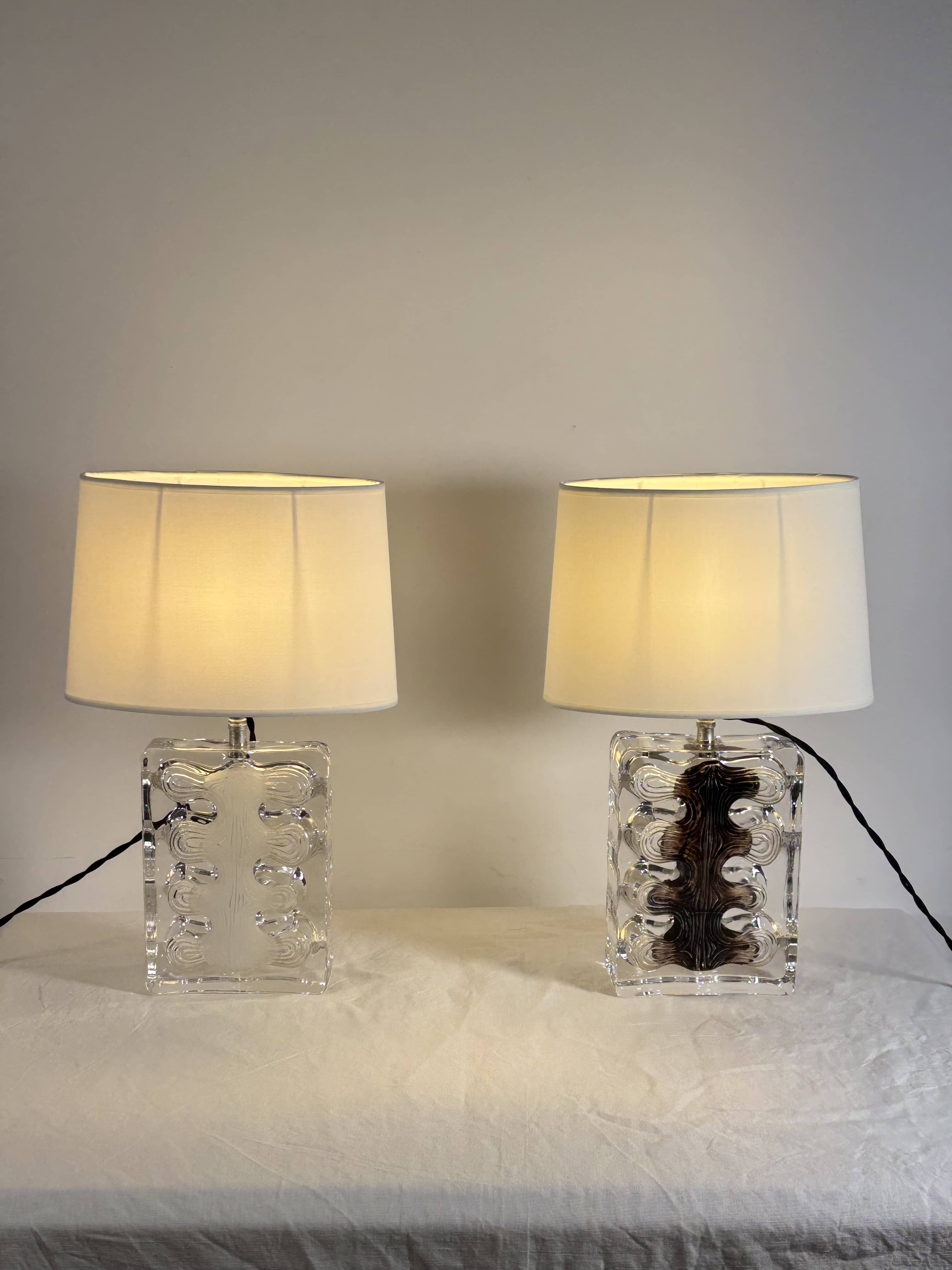
Pair of lamps with rectangular solid crystal bases, Lynx model, created in 1973 by the sculptor Jean-Pierre Demarchi, then artistic director of the Daum crystal works.
The crystal, hollowed with a biomorphic form of symmetrical scrolls, is enhanced by a column of white opaline crystal on one of the two bases and brown crystal on the other — a variation in tone that distinguishes each piece without breaking the unity of the pair.
The interplay between the transparency of the crystal and the matte finish of the central appliqué captures the light with striking sculptural presence, faithful to Demarchi’s approach, which regarded crystal as a material in its own right, on a par with bronze or stone.
The strength of this pair lies in its bold chromatic and textural contrast.
Signed Daum France on each base.
Newly rewired to current standards by a professional.

An important and rare rectangular ritual perfume burner in hardwood carved in relief, retaining superb traces of polychromy and Cinnabar-style red lacquer.
This cult vessel of exceptional dimensions, intended for incense offerings upon a major altar or within a temple, is distinguished by the strength of its lines and the quality of its carved elements.
The two impressive lateral handles, animated in reversed S-form, give the object its full presence. They are carved in low relief with a scroll of blossoming lotus flowers, the Buddhist symbol of purity.
The perfume burner rests upon four vigorous feet, carved in the round with heads of protective mythical creatures, heightened with red lacquer.
The body displays cyma-moulded panels of great structural sobriety, contrasting elegantly with the exuberance of the handles and the base.
One of the lateral faces of the body bears a rare ritual inscription incised with six sinograms, perfectly integrated into the patina of the wood. Translation: “Respectfully offered by (or in memory of) Yu Lin Shizhang”.
This nominative dedication attests that this perfume burner is an object of worship and devotion commissioned by a family or a lettered devotee.
Weight: 7,600 g
Galerie Bleu Magenta brings together a singular selection of antiques, vintage design and decorative arts, ranging from 18th-century furniture to 1970s Murano lighting, with signed 20th-century ceramics in between. Each piece is chosen with exacting care for its aesthetic value, its authenticity and its ability to converse with contemporary interiors. The gallery champions a vision of sustainable, responsible luxury, where beauty circulates, is passed on and grows richer over time. Exploring our catalogue, you will discover antique furniture, baroque mirrors, Italian glass, period seating, decorative objects and rare creations, all selected for their refinement and singularity.

I recently bought a handcrafted lamp from Bleu Magenta and I am completely won over! The unique design and exceptional quality really impressed me. The customer service was also flawless, with personalised advice and quick delivery.
I found the perfect gift for my best friend's birthday: a set of handmade ceramic vases. Not only were they beautiful, but the story behind each creation added a personal touch that made my gift even more special!